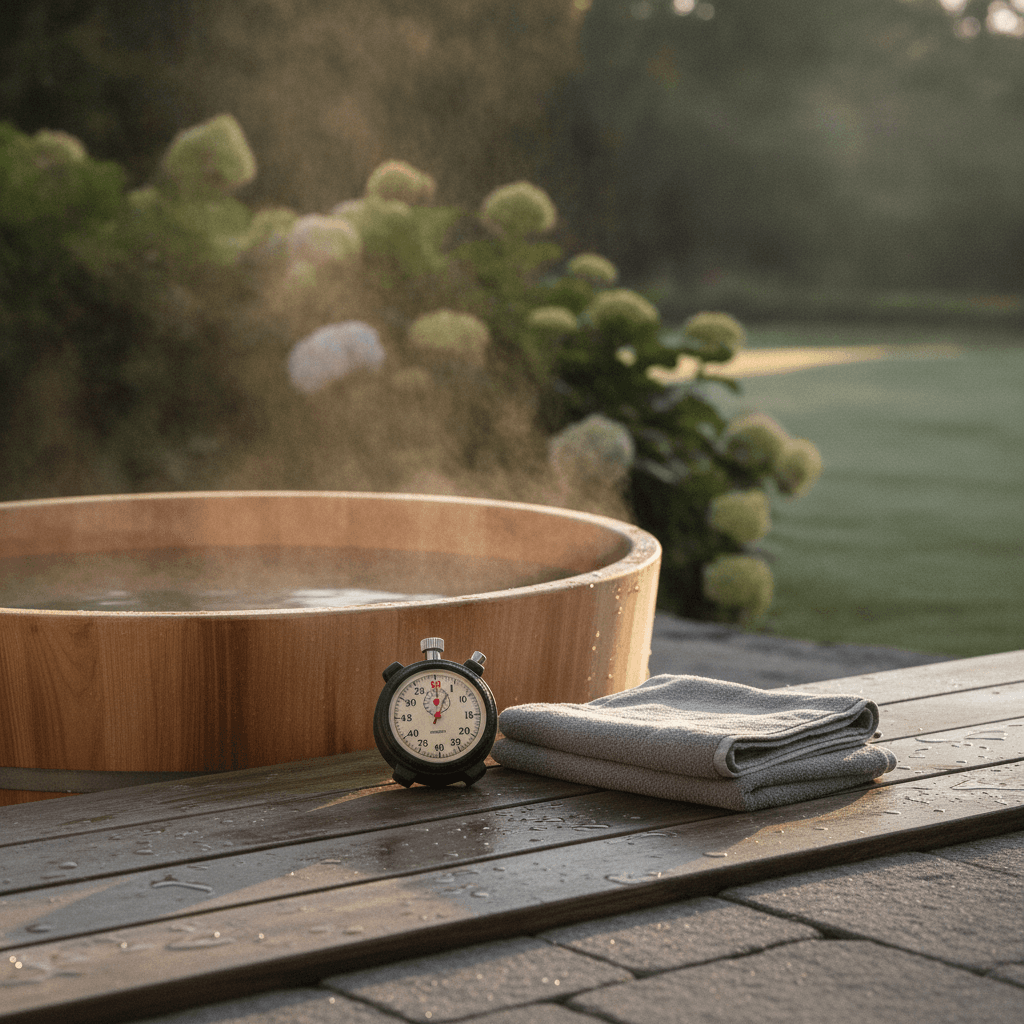
How many minutes per session and how many times a week to cold plunge, from beginner to experienced, based on Cleveland Clinic guidance and Søberg research.
Plunge Type
Quick answer: Most healthy beginners start with 30 seconds to 2 minutes, once or twice a week. Build toward 2 to 5 minutes, 2 to 4 times a week, as tolerance improves. Cleveland Clinic advises a session never go past five minutes. The research behind Dr. Susanna Søberg's popular '11-minute rule' studied Danish winter swimmers who plunged 2 to 3 times a week, and it supports short, frequent sessions over long, rare ones. Going longer or colder than that has not been shown to add benefit, and it does add risk.
Best for
Buyers who already have a plunge, or are close to buying one, and want the actual dose: minutes per session, sessions per week, and how that changes as you adapt.
Wrong fit
Buyers still deciding on plunge type or budget, and anyone with a heart condition, high blood pressure, pregnancy, or another condition that needs medical clearance first.
Tradeoff
More minutes and more sessions is not automatically better. The evidence favors short, frequent, moderate exposure over long or daily maximal sessions, which add risk without proven extra benefit.
Everyone selling a cold plunge has an opinion on how long to stay in. Most of them are guessing.
The honest version is shorter than the Instagram version: a few minutes, a few times a week, is where the evidence actually points. We don't sell cold plunges, so there is no reason to tell you to stay in longer than you need to.
Quick Answer
Experience
Time per session
Sessions per week
Week 1 to 2 (new)
30 seconds to 2 minutes
1 to 2
Week 3 to 8 (building)
2 to 3 minutes
2 to 3
Adapted, ongoing
3 to 5 minutes
2 to 4
Cleveland Clinic's general guidance: beginners cap sessions at one to two minutes and plunge once or twice a week at first, and a session should never run past five minutes even once you have adapted. Some people tolerate a plunge most days as tolerance builds, but neither the clinical guidance nor the research behind the popular "11-minute rule" argues for going longer than that to get more benefit.
How long: build time gradually, not by the calendar
Time in the water should track how your body responds that day, not a fixed script. Start at the shorter end of your bracket, especially in a first session at a given temperature. If you are still deciding what temperature to plunge at, pair this with the temperature guide: colder water means less time, not more, so a 40°F (4°C) session should always be shorter than a 55°F (13°C) one.
Signs to get out immediately, regardless of the clock: uncontrolled gasping, numbness that does not ease, dizziness, or a racing or irregular heartbeat. None of the duration guidance below overrides that.
How often: the "11-minute rule" and what it actually says
The number that gets repeated most is 11 minutes of cold exposure a week, split across 2 to 3 sessions. It comes from Danish metabolism researcher Dr. Susanna Søberg, who studied Copenhagen winter swimmers and popularized the figure through her work with Dr. Andrew Huberman.
Here is the part most recaps skip: the peer-reviewed study behind that work, published in Cell Reports Medicine in 2021, tracked winter swimmers who plunged 2 to 3 times a week and found altered brown-fat thermoregulation and stronger cold-induced heat production compared to non-swimmers. The paper itself does not print an exact "11 minutes" prescription. That specific weekly target is Søberg's own practical recommendation, drawn from her research and explained in interviews and podcasts, not a line from the journal article. It is a reasonable rule of thumb, not a clinical guarantee, and cold-exposure science is younger and less settled than sauna research. Treat it as a starting point, not a target you have to hit.
Søberg's own caution matters as much as the number: she recommends against daily maximal cold exposure, describing cold as a potent stressor that needs recovery time between sessions, and summarizes her own advice as "less is more."
Why the dose matters before you buy, not just after
This is the question that should shape your purchase, not just your routine. If you realistically plan 2 to 4 short sessions a week for months, the deciding factor is whether your setup can hold a consistent, moderate temperature without turning every session into a chore. Bagged ice runs out fast at that frequency and gets expensive; an undersized chiller struggles to recover between back-to-back sessions in a household. The chiller sizing guide walks through matching chiller capacity to how often you actually plan to plunge, and the real cost guide prices out what that consistency costs monthly.
If you are still testing whether the habit sticks, do not buy for the finished protocol yet. A cheap stock tank and bagged ice covers 1 to 2 sessions a week for a few months at a fraction of the cost, which is exactly the test the beginner's guide recommends before committing to a powered setup.
Safety limits that override any protocol
No duration or frequency target applies if you have a condition that makes cold exposure risky in the first place. Heart disease, uncontrolled high blood pressure, pregnancy, and several other conditions call for medical clearance before any of the numbers above apply to you. Read when not to cold plunge before you set a routine, and never plunge alone regardless of how many minutes you plan to stay in.
Frequently Asked Questions
Is it better to do one long cold plunge or several short ones?
Several short ones. Both the clinical guidance and the research behind the 11-minute rule favor splitting cold exposure across 2 to 3 sessions a week rather than one long session, and the underlying study specifically tracked swimmers who went in 2 to 3 times a week.
Can I cold plunge every day?
Some people build up to a daily plunge, but neither Cleveland Clinic nor Søberg's own guidance treats daily maximal sessions as necessary or better. Søberg specifically recommends against daily cold stress because it can crowd out recovery.
What happens if I stay in longer than 5 minutes?
Cleveland Clinic advises against sessions longer than five minutes. Longer exposure raises the risk of excessive heart rate and blood pressure changes and does not have evidence showing extra benefit over shorter, consistent sessions.
Does colder water mean I should stay in longer?
No. Colder water should mean less time, not more. See the temperature guide for how time and temperature trade off.
How soon will I notice a difference?
Individual response varies and is not well studied for short home-use timelines. The winter-swimmer research behind the 11-minute rule followed habitual swimmers over a year, not a few weeks, so treat early sessions as building tolerance rather than expecting fast, measurable metabolic change.
These guides are built from manufacturer documentation, public specifications, primary research where health claims matter, and repeated buyer questions that show up in real ownership and setup decisions.
Manufacturer responses can clarify pricing bands, warranty terms, support footprint, or common mistakes. They do not move a page up the shortlist on their own.