What temperature to set your cold plunge in °F and °C, beginner vs experienced ranges, how temp and time interact, and why colder is not better.
Plunge Type
Quick answer: Most people use a cold plunge between 45 and 60 degrees Fahrenheit (7 to 16 Celsius). Beginners do well starting at 55 to 60°F (13 to 16°C) and staying a minute or two. Experienced plungers often go 45 to 50°F (7 to 10°C). Colder water means you should stay in for less time, not more, and below 39°F (4°C) adds risk without adding much.
Best for
Someone who has water access and needs to know what number to actually set the dial to.
Wrong fit
Buyers still deciding whether to get a plunge at all, or which type to buy.
Tradeoff
Colder water feels more hardcore but forces shorter, more careful sessions, so warmer and longer is often the smarter setting.
Most cold plunges run between 45 and 60 degrees Fahrenheit (7 to 16 Celsius). That is the honest whole answer. Where you land inside that range depends on how new you are, how long you want to stay in, and what feels sustainable. If you are picking a number to start with, 55 to 60°F (13 to 16°C) is a smart, effective place to begin, and you can work colder over weeks.
The thing to unlearn first: colder is not automatically better. A lot of the internet treats the temperature dial like a difficulty score, where 38°F makes you tougher than the person at 52°F. It does not work that way. Below a certain point you get more risk and more misery without a matching payoff. This guide gives you real ranges, shows how temperature and time trade off against each other, and explains where the useful cold ends and the pointless suffering begins.
Cold water has real contraindications, so read when not to cold plunge before you chase a colder number, especially if you have any heart or blood pressure history.
Quick Answer
Set your plunge based on experience, and let colder water shorten your session, not lengthen it.
Level
Temperature
Typical time
Notes
First time
55 to 60°F (13 to 16°C)
30 sec to 1 min
Still a real plunge, far less scary
Building tolerance
50 to 55°F (10 to 13°C)
1 to 3 min
The common "comfortable cold" zone
Standard cold plunge
45 to 50°F (7 to 10°C)
1 to 3 min
Where many regular plungers settle
Experienced
39 to 45°F (4 to 7°C)
1 to 2 min
Short sessions only, know your limits
True ice / below 39°F (4°C)
Under 39°F (4°C)
Under 1 min
Diminishing returns, higher risk, not for beginners
We use Fahrenheit first because our readers are mostly in North America, with Celsius in parentheses. If your unit reads in Celsius, use the bracketed number.
Beginner vs experienced ranges
If you are new, start at 55 to 60°F (13 to 16°C). This surprises people who assume a real cold plunge has to be near freezing. It does not. Water in the high 50s is genuinely cold, triggers the same "get in and breathe" challenge, and lets you build the habit without the first session scaring you off for good. Most beginners who quit did so because they went too cold, too fast, on day one.
As it gets easier, drop to 50 to 55°F (10 to 13°C). This is the zone a lot of people settle into and never leave. It is cold enough to be a real event and warm enough that you can stay in long enough to relax into it. There is nothing beginner about staying here for good.
Experienced plungers often use 45 to 50°F (7 to 10°C), and some go colder. If you have been doing this for months and want more of a jolt, dropping into the 40s makes sense. Below 39°F (4°C) you are in true ice territory. That is fine for people who know exactly what they are doing, but the extra cold buys you very little and asks a lot more of your body's cold shock response. This is not the place beginners should aim.
Where you settle is personal. The best temperature is the coldest one you will actually get into several times a week, not the coldest one you can survive once.
How temperature and time work together
Temperature and duration are a pair. You do not set them separately, you trade one against the other. The colder the water, the shorter you should stay in.
A rough way to think about it:
Warmer water (55 to 60°F / 13 to 16°C): you can comfortably stay 2 to 5 minutes.
Middle range (48 to 55°F / 9 to 13°C): 1 to 3 minutes is plenty.
Colder water (39 to 47°F / 4 to 8°C): keep it short, roughly 1 to 2 minutes.
Below 39°F (4°C): under a minute, and only if you are experienced.
Total time across the week matters more than any single heroic session. Most regular plungers land at a few minutes per session, a handful of times a week. You do not need to chase big numbers. Short and consistent beats long and dreaded. The duration and frequency guide goes deeper on how long and how often to plunge.
One safety note that belongs here: getting out too slowly from very cold water can leave you feeling worse, not better, because your body keeps cooling for a few minutes after you exit. That "after-drop" is another reason colder does not mean longer. Warm up gently afterward and do not rush a very cold session.
Why colder is not automatically better
This is the myth worth killing. There is a common assumption that if some cold is good, near-freezing must be better. The evidence does not support treating the thermometer as a scoreboard.
Three plain reasons to stop chasing colder:
The returns flatten out. The jump from a warm shower to 55°F (13°C) water is enormous. The jump from 50°F (10°C) to 40°F (4°C) is much smaller in terms of what you actually get, while the discomfort and the cold shock response climb steeply.
The risk climbs faster than the benefit. Colder water hits your breathing and heart rate harder in the first seconds. For anyone with a cardiac or blood pressure history, that matters a lot. Read when not to cold plunge and take it seriously.
Consistency is the real driver. Whatever cold water does for you, it does it through regular use, not through one brutally cold session. A temperature you dread is a temperature you will skip. The setting you keep is the one that works.
The science on cold exposure is younger and more contested than sauna science, and we would rather say that plainly than pretend a specific magic temperature is proven. What is clear is that "colder equals better" is marketing, not fact.
Practical settings by situation
Testing the habit: start at 58°F (14°C), stay a minute, get out. Adjust down only when that feels easy.
Morning wake-up plunge: many people like 50 to 55°F (10 to 13°C) for a sharp, clean jolt that is still pleasant enough to want tomorrow.
Contrast therapy after a sauna: you do not need it brutally cold. The temperature difference does the work, so 50 to 60°F (10 to 16°C) is plenty. See the sauna and cold plunge routine on our sister site for how to pair them.
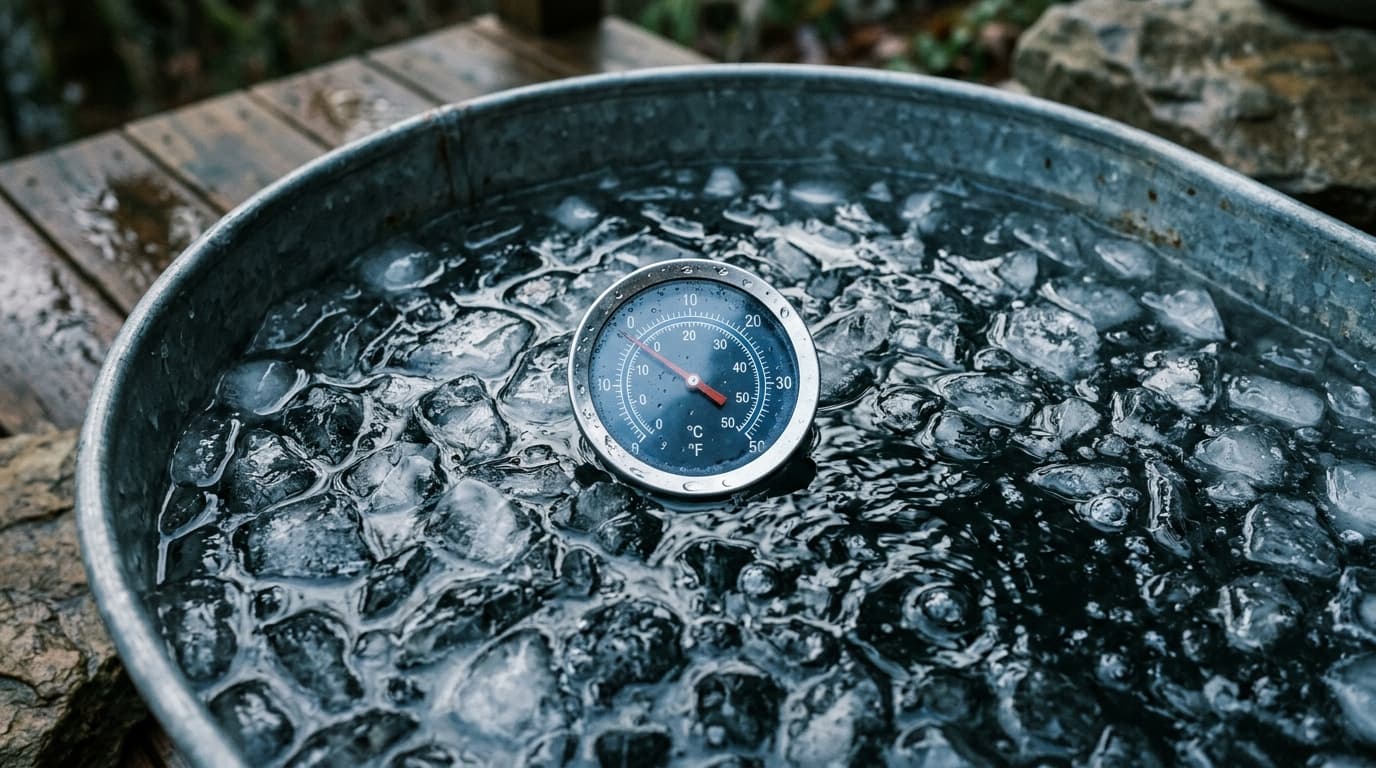
No chiller, using ice: your realistic floor depends on how much ice you buy and the weather. Aim for a target and measure it with a cheap thermometer rather than guessing. A chiller is what makes a precise, repeatable temperature easy, and it is the main thing you pay for when you move up from a stock tank.
Frequently Asked Questions
What is the best temperature for a cold plunge?
For most people, somewhere between 45 and 55°F (7 to 13°C) hits the sweet spot of cold enough to matter and sustainable enough to repeat. Beginners should start warmer, around 55 to 60°F (13 to 16°C), and work down. The best temperature is the one you will actually use several times a week.
Is 39°F (4°C) too cold?
For a beginner, yes. 39°F (4°C) is true ice-bath territory and belongs to experienced plungers doing short sessions who understand their limits. The extra cold below the mid-40s adds risk faster than it adds benefit, so there is no reason to rush there.
How does temperature change how long I stay in?
They trade off. Warmer water (mid to high 50s) supports 2 to 5 minutes. Colder water (low 40s) should be kept to 1 to 2 minutes or less. Let the temperature set the time, and never extend a very cold session just to prove a point.
Should the water be colder for more benefit?
No. Below the mid-40s the returns flatten while discomfort and the cold shock response climb. Whatever cold water does for you comes from doing it regularly, not from a single near-freezing session. Consistency beats extremity.
How do I keep the water at a set temperature?
A chiller holds a precise temperature all day, which is the main convenience you buy when moving up from ice. With ice alone, the temperature drifts with the weather and how much ice you add, so use a thermometer. The cold plunge chiller guide covers sizing by climate.
These guides are built from manufacturer documentation, public specifications, primary research where health claims matter, and repeated buyer questions that show up in real ownership and setup decisions.
Manufacturer responses can clarify pricing bands, warranty terms, support footprint, or common mistakes. They do not move a page up the shortlist on their own.