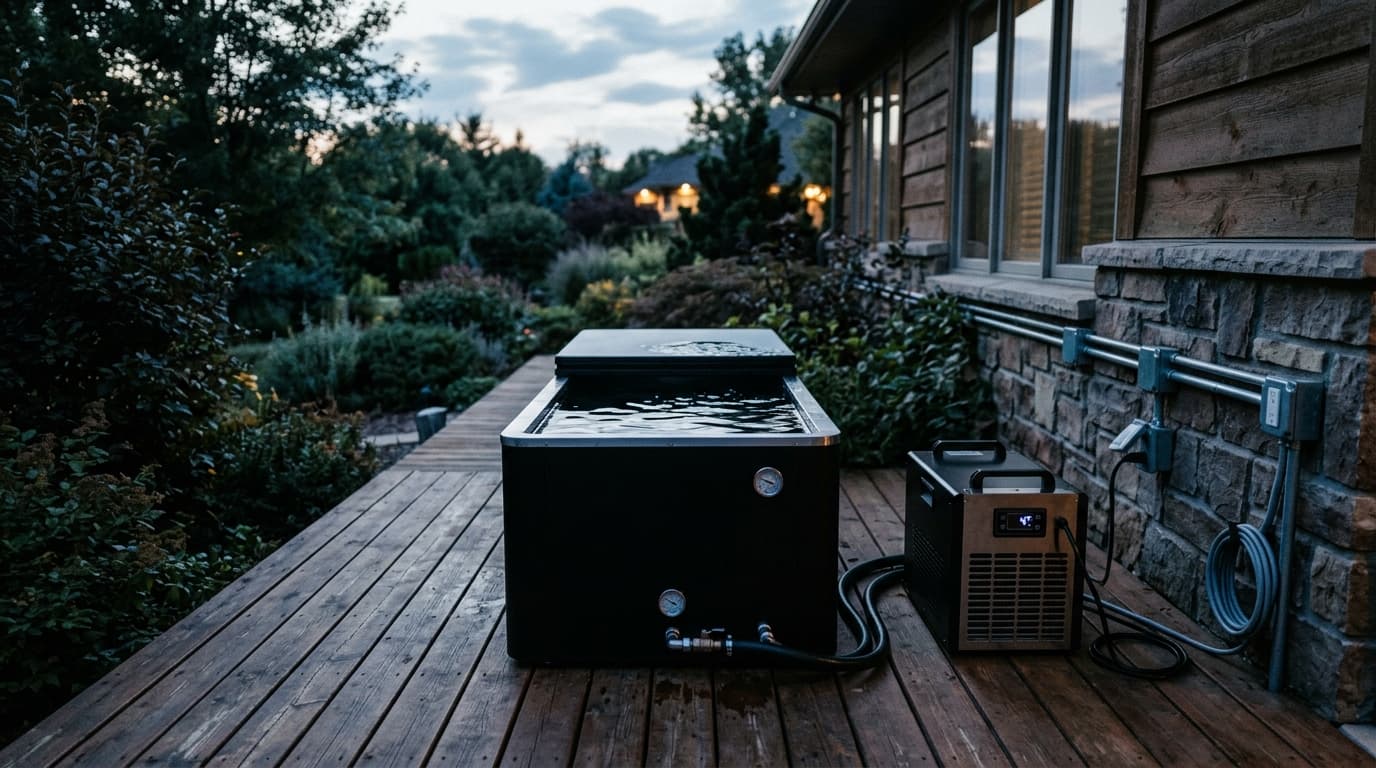
A cold plunge tub is half the purchase. Real all-in numbers for the chiller, GFCI outlet, water care, and $10 to $40 a month in electricity.
Budget
Quick answer: A cold plunge costs more than the tub. Budget $4,000 to $16,000 all-in for a powered plunge with a properly sized chiller (premium true-ice machines run $12,490 to $35,990), or roughly $1,500 to $3,500 if you pair an unpowered tub with a separate chiller. On top of the hardware, plan for a dedicated outdoor GFCI outlet, water treatment, and $10 to $40 a month in electricity. Undersized chillers are the number one regret, so size for your climate, not the brochure.
Best for
Buyers pricing the full cold plunge project, not just the tub, before they put down a deposit.
Wrong fit
Buyers who already have the all-in budget set and just need a shortlist of credible brands.
Tradeoff
The lower the tub sticker price looks, the more of the real cost is hiding in the chiller, the electrical work, and the water care you buy separately.
A cold plunge is not a $6,000 purchase. It is a $6,000 tub attached to a chiller, a dedicated outlet, a water-care habit, and a monthly power draw that the product page never adds up for you. The tub is half the purchase.
That is the number people actually need before they buy. We don't sell cold plunges. We save you from buying the wrong one, and the fastest way to buy the wrong one is to price the tub and forget everything bolted to it. This guide prices the whole project.
If you are further along and want the shortlist, jump to the best cold plunge roundup. If you are stuck on the single biggest cost driver, read the chiller sizing guide next, because that one decision moves your budget more than the brand does.
Quick Answer: What a Cold Plunge Actually Costs
Setup
Tub sticker price
Chiller
Real all-in cost
Powered plunge with built-in chiller
$3,590-$15,000 (true-ice to $35,990)
Included
$4,000-$16,000+
Unpowered tub or barrel + separate chiller
$100-$1,750
Bought separately, $500-$1,500 (est.)
$1,500-$3,500
Portable or travel system
$2,495-$2,990
Included
$2,500-$3,500
DIY stock tank or chest freezer + chiller
$100-$400
Separate
$700-$2,500
Powered plunge brands like Plunge, Sun Home, and Renu Therapy sit in the $3,590 to $15,000 band, with the premium true-ice tier from Morozko Forge ($12,490 to $35,990) and BlueCube ($12,750 to $29,000) above them. Unpowered tubs and barrels like the Ice Barrel run $100 to $1,750, but they need ice or a chiller you buy on top. Portable systems from Inergize land between $2,495 and $2,990 with the chiller included. (Edge Theory Labs, once the other portable name, is out of business, so its tubs are secondhand only.) Those are sticker prices. The all-in column is the one that matters.
The Five Costs the Product Page Skips
1. A correctly sized chiller
This is the one that turns a good purchase into a regret. An undersized chiller cannot pull your water down to temperature and hold it there on a hot day, so you get a tub that sits at 60F (16C) in July when you wanted 45F (7C). Undersized chillers are the single most common cold plunge regret, and the market is full of "1 HP" units from the same factories that are marketed hard and underpowered in practice.
If your plunge has a built-in chiller, the sizing is done for you, which is a real part of what you pay for. If you are pairing an unpowered tub with a separate chiller, budget $500 to $1,500 (estimate) and size it for your climate, not the smallest unit that fits the price. The full breakdown is in the chiller sizing guide.
2. A dedicated outdoor GFCI outlet
A powered plunge or a standalone chiller needs its own weatherproof, GFCI-protected outlet. Running an extension cord to a garage outlet is how people cook a plunge's electronics and void a warranty. If you already have a suitable outlet within reach, this is close to free. If you need an electrician to run a dedicated GFCI circuit to the patio, plan for a real line item, often a few hundred dollars and up depending on the run and your panel.
This is not optional and it is not a place to improvise. Water plus electricity plus a shared household circuit is exactly the setup safety guidance tells you to avoid.
3. Water treatment you keep paying for
Cold water still grows things. You have two paths. Treat the water with ozone, UV, a filter, or sanitizer so you change it every few weeks to a couple of months, or skip treatment and commit to draining and refilling roughly weekly. Most powered plunges include filtration and often ozone or UV. Unpowered tubs usually do not, so a DIY setup means either buying a treatment add-on or accepting the water-change chore.
Neither path is free. Filters, ozone cartridges, and sanitizer are ongoing costs, and frequent water changes are a water bill plus your time. We cover the tradeoffs in the water maintenance guide.
4. Electricity: $10 to $40 a month
The running cost surprises people less than they fear. Most home cold plunges add $10 to $40 a month to the power bill, driven by your climate, target temperature, how well the tub is insulated, and whether it is indoors or out. A well-insulated tub holding 50F (10C) in a mild climate sits at the low end. An outdoor tub chilled to the mid-40s in a hot summer climate sits at the high end, sometimes higher. Treat any single monthly figure you see as an estimate until you have run it through your own rates and climate. For the actual chiller wattage specs, the current U.S. electricity rate, and the formula behind that range, see the cold plunge electricity cost guide.
5. Indoor installs: condensation and 800-plus pounds
If the plunge is going inside, two costs hide in the building, not the box. A tub full of water is heavy. Filled, many plunges clear 800 pounds, so you need a floor that can carry it, which rules out some second floors and lightweight decks without reinforcement. And a pool of cold water in a warm room sweats. Condensation on the tub, the floor, and nearby surfaces is real, and managing it can mean a mat, a dehumidifier, or better ventilation. Outdoors, both problems mostly disappear.
Brochure Number vs Real Number: A Worked Example
Take the classic matchup from every buyer's shortlist: the $5,590 The Plunge versus a $1,150 Ice Barrel 300 plus a chiller.
Line item
$5,590 The Plunge
Ice Barrel 300 + chiller
Tub
$5,590
$1,149.99
Chiller
Included
$500-$1,500 (est. third-party); Ice Barrel's own is $3,999.99
GFCI outlet
Same for both
Same for both
Water care
Filter/ozone included
Add-on or water changes
Real all-in
~$5,600-$6,100
~$1,900-$3,100 with a third-party chiller
The Plunge is not overpriced for what it is. You pay for a matched, sized chiller, built-in water care, warranty support, and plug-and-play install. If you want that and you value your weekends, it earns the price. If you are handy, patient, and willing to size and wire a separate chiller yourself, the Ice Barrel path does a similar job for well over $2,000 less. That is the real decision, and it is covered head to head in Plunge vs Ice Barrel.
The unflattering truth about the premium lane: a built-in chiller you cannot service or upsize is a sealed system. When it fails out of warranty, you are often looking at a service call or a replacement, not a $600 swap. The separate-chiller path is uglier and louder, and it is also more repairable.
How to Budget by Your Situation
If you want plug-and-play and low hassle
Budget the full powered-plunge number, $4,000 to $16,000-plus all-in, and confirm the chiller is sized for your hottest month. You are buying the tub, the matched chiller, the water care, and the warranty as one product. That is a fair trade for a lot of buyers.
If you want to spend the least and do not mind work
Start with an unpowered tub or a stock tank and add a properly sized separate chiller when you are ready, or run on bagged ice while you decide. All-in, this lands around $700 to $3,500 depending on the chiller. It is the path that most often beats a $6,000 tub for the right person.
If you are still not sure you will stick with it
Do not buy the $6,000 tub to find out. A stock tank and ice, or a chest freezer conversion with the safety work done correctly, tests the habit for a few hundred dollars. Most testers who keep the habit upgrade within a year, and they upgrade smarter for having started cheap.
If you want the cumulative number instead of the moment-of-purchase number, the 2-year cost comparison lines up a powered plunge, a barrel plus a separate chiller, and a stock tank plus ice side by side with a real 24-month total for each.
Before you commit either way, it is worth reading the cold plunge buying regrets so you make someone else's expensive mistake for free. And if you have any cardiac history or blood pressure concerns, read when not to cold plunge first. That page does not sell anything.
Frequently Asked Questions
How much does a cold plunge really cost all in?
Budget $4,000 to $16,000-plus for a powered plunge with a built-in chiller (true-ice machines run $12,490 to $35,990 before freight), or roughly $1,500 to $3,500 if you pair an unpowered tub with a separate chiller. On top of the hardware you have a dedicated GFCI outlet, water treatment, and $10 to $40 a month in electricity. The tub sticker price is the deposit on the project, not the bill.
Is a $5,590 Plunge worth it over a $1,150 Ice Barrel and a chiller?
It depends on whether you are buying convenience or doing the work. The Plunge includes a matched chiller, water care, and warranty support and installs plug-and-play, which lands the all-in near $5,600 to $6,100. An Ice Barrel 300 plus a separate third-party chiller does a similar job for about $1,900 to $3,100 all-in, but you size, wire, and maintain more of it yourself. Neither is a rip-off. They serve different buyers.
What is the hidden cost nobody mentions?
The chiller sizing. An underpowered chiller that cannot hold your target temperature on a hot day is the most common regret, and it is the cost most often left off the tub's product page. After that come the dedicated GFCI outlet, ongoing water treatment, and for indoor tubs, condensation and 800-plus pounds of filled weight on the floor.
How much does a cold plunge add to my electric bill?
Most home cold plunges run $10 to $40 a month. Your number depends on climate, target temperature, insulation, and indoor versus outdoor placement. A well-insulated tub in a mild climate sits at the low end. An outdoor tub chilled to the mid-40s through a hot summer sits at the high end. Treat any single figure as an estimate until you run it against your own rates.
Do I need a special outlet for a cold plunge?
Yes. A powered plunge or a standalone chiller needs its own weatherproof, GFCI-protected outlet, ideally on a dedicated circuit. Do not run it off an extension cord or a shared garage outlet. If you need an electrician to add a dedicated GFCI outlet outdoors, budget a few hundred dollars and up depending on the run and your panel.
How much does an indoor cold plunge weigh when full?
A lot. Filled with water, many plunges clear 800 pounds, so an indoor or upper-floor install needs a floor rated to carry it. That, plus condensation in a warm room, is why indoor plunges cost more to set up than the same tub outdoors, even though the box price is identical.
Methodology
These guides are built from manufacturer documentation, public specifications, primary research where health claims matter, and repeated buyer questions that show up in real ownership and setup decisions.
Manufacturer responses can clarify pricing bands, warranty terms, support footprint, or common mistakes. They do not move a page up the shortlist on their own.