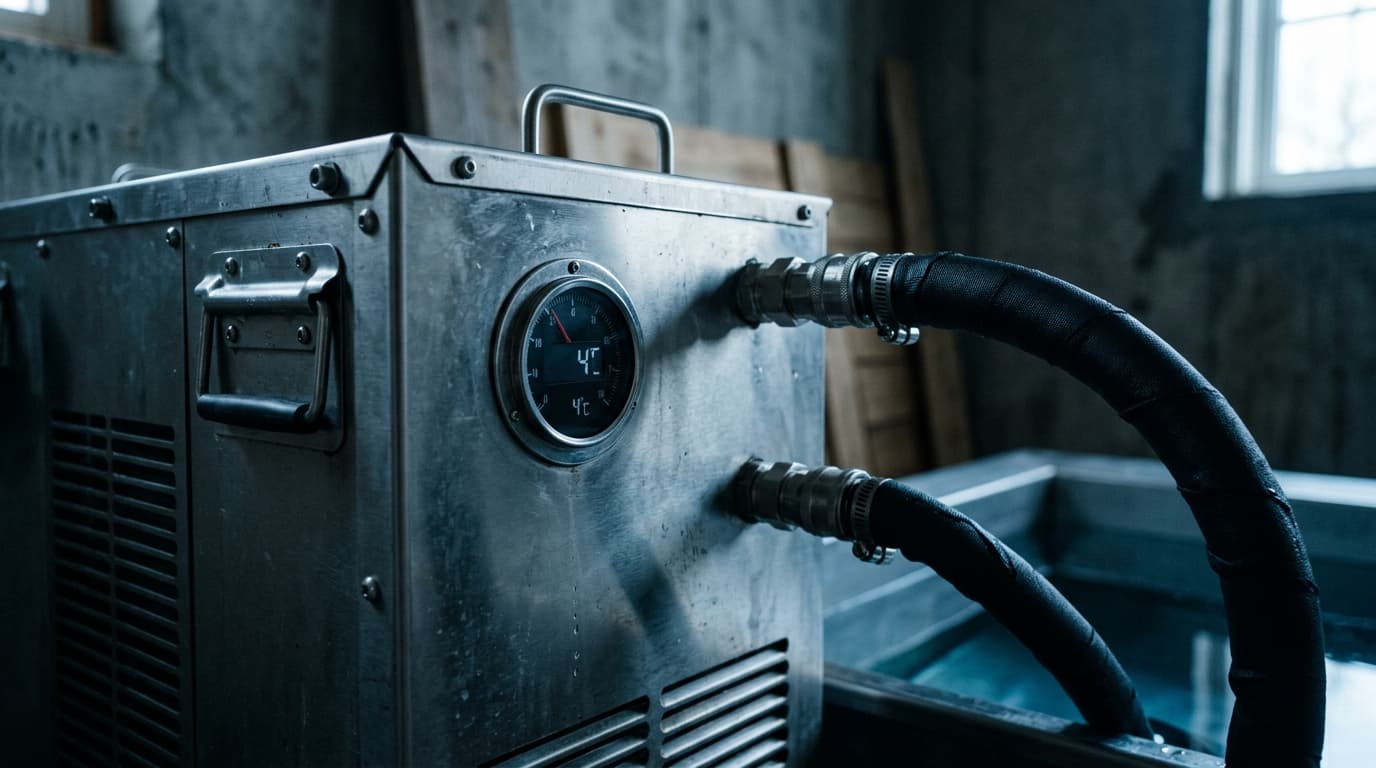
How to size a cold plunge chiller by climate, why an undersized unit is the number one regret, and what it costs to run each month.
Setup
Quick answer: Size a cold plunge chiller for your hottest month and your target temperature, not the smallest unit that fits the budget. The spec that matters is cooling capacity in BTU per hour, not the marketing 'HP' number, which is not standardized across brands. A well-insulated tub in a mild climate needs far less than an outdoor tub chilled to the mid-40s through a hot summer. An undersized chiller that cannot hold temperature on a hot day is the single most common cold plunge regret, and most chillers add $10 to $40 a month to the power bill.
Best for
Buyers pairing an unpowered tub with a separate chiller, or checking that a powered plunge is sized for their climate.
Wrong fit
Buyers who have not yet chosen between a powered plunge and an unpowered tub.
Tradeoff
A bigger chiller costs more up front and holds temperature on the hottest day. A smaller one saves money right up until the first heat wave.
The chiller is the part that decides whether you got a cold plunge or an expensive tub of cool water. Get it too small and it runs all day, still loses the race in July, and drives up your power bill while it fails. Undersized chillers are the single most common cold plunge regret, and it is the one mistake you cannot fix cheaply. You buy a second chiller.
We don't sell cold plunges. We save you from buying the wrong one, and in this category the wrong chiller sinks more setups than the wrong brand does. If you are pairing an unpowered tub with a separate chiller, or you want to check that a powered plunge is sized for where you live, this is the number to get right. For the full budget picture first, see the real cost of a cold plunge.
Quick Answer: How to Size a Chiller
Your situation
Rough chiller class (estimate)
Why
Indoor or shaded, mild climate, target ~50F (10C), well insulated
Outdoor sun, hot summer, target mid-40s (7C) or colder
Larger unit, 1 HP class or more
Fighting real heat all day
Treat those HP classes as estimates, not specs. What actually matters is cooling capacity in BTU per hour and how fast the unit pulls water down and holds it in your climate. Manufacturer "HP" labels are not standardized, so one brand's "1 HP" is not another's. When in doubt, size up.
Why "HP" Is the Wrong Number to Shop On
The whole category advertises chillers in horsepower, and it is close to meaningless as a comparison. A "1 HP" chiller from one factory can move a very different amount of heat than a "1 HP" chiller from another, because the label describes the compressor, not the delivered cooling. The number that tells you the truth is BTU per hour of cooling capacity, and the brands worth buying will give it to you. Ask for it in writing.
This matters because the dropship lane leans on the "1 HP" label hard. Hundreds of white-label inflatable tubs ship with a "1 HP" chiller that looks competitive on paper and cannot hold the mid-40s on a hot afternoon. The spec sheet wins the sale and the summer loses it. If a seller cannot or will not give you a BTU per hour figure, that tells you something.
Sizing by Climate and Target Temperature
Four things drive how much chiller you need. Two you control, two you do not.
Ambient temperature. The bigger the gap between the air and your target water temp, the harder the chiller works. An outdoor tub in a hot climate is the worst case.
Target water temperature. Holding 50F (10C) is far easier than holding 45F (7C), and every degree colder is more work.
Insulation and cover. An insulated tub with a good cover holds cold like a cooler. A bare tank leaks it, and the chiller pays the difference.
Indoor vs outdoor and sun exposure. Direct sun on the tub is a heater you did not ask for. Shade and indoor placement cut the load.
Mild climate or indoor
If your tub lives indoors or in shade in a mild climate, is well insulated, and you are happy around 50F (10C), you are in the easy case. A smaller chiller in roughly the 1/4 to 1/2 HP class (estimate) can pull it down and hold it while cycling gently. This is the cheapest setup to run and the quietest.
Moderate climate, outdoor
An outdoor tub in a place with real summers, targeting 45 to 50F (7 to 10C), needs more. Plan for roughly the 1/2 to 1 HP class (estimate) and prioritize insulation and a cover, because they do half the work. A well-insulated tub with a mid-size chiller beats a bare tub with a big one.
Hot climate or aggressive cold
If you want the mid-40s or colder, outdoors, through a hot summer, this is where undersized units die. Size to the 1 HP class or larger (estimate), or buy a unit rated well above the marketed minimum for your tub volume. This is also where a built-in chiller on a powered plunge earns its money, because the brand sized it for you. If you are going the separate-chiller route in a hot climate, oversize on purpose.
Why Undersized Is the Number One Regret
Here is the failure mode, because it is worth seeing before you buy. On a mild day, an undersized chiller looks fine. It holds temperature and you feel smart for saving money. Then the first heat wave arrives. The chiller runs nonstop, the water still creeps up to 55, 58, 60F (13 to 16C), and the cold you bought the tub for is gone on the days you most wanted it. Running flat out for months also wears the compressor faster and adds more to the power bill than a right-sized unit that cycles on and off.
And you cannot patch it. A chiller that is too small does not get bigger. The fix is a second, larger chiller, which means you paid for two. That is why "buy small to save money" is the most expensive advice in this category, and why it tops the cold plunge buying regrets. A right-sized or slightly oversized chiller cycles less, runs quieter, holds temperature on the worst day, and lasts longer. Oversizing costs a little more up front and almost nothing to regret.
What It Costs to Run
The running cost is smaller than the fear. Most cold plunge chillers add $10 to $40 a month to the power bill, and the range is driven by the same four factors as sizing.
Setup
Climate
Estimated monthly electricity
Well-insulated tub, indoor or shade, target ~50F
Mild
~$10-$20 (est.)
Outdoor tub, real summer, target 45-50F
Moderate
~$20-$30 (est.)
Outdoor tub in sun, target mid-40s, hot summer
Hot
~$30-$40+ (est.)
These are estimates. Your bill depends on local electricity rates, how cold you run it, and how well the tub is insulated. A right-sized chiller on a well-insulated, covered tub sits at the low end because it cycles instead of running constantly. An undersized chiller in the sun runs at the high end precisely because it never gets to rest. Better insulation is the cheapest way to cut the number. For the actual wattage math behind these numbers, see the cold plunge electricity cost guide.
Buying the Chiller: Built-In vs Separate
If you buy a powered plunge, the chiller is built in and sized to the tub, which is a real part of what you pay for and one less thing to get wrong. The tradeoff is that a sealed built-in chiller is not something you can service or upsize later, and it turns the whole tub into a single point of failure. A split setup, a tub or barrel plus a separately bought chiller, trades that convenience for a repair the tub itself never has to sit out. See all-in-one vs separate chiller for the full failure-mode, repair-cost, and warranty-exclusion breakdown, and the warranty and serviceability comparison for each brand's chiller-specific terms.
If the tub will live outdoors through a hot summer, the hot-climate powered-plunge shortlist compares the matched systems by documented capacity, insulation, warranty and service path.
If you pair an unpowered tub like an Ice Barrel with a separate chiller from a maker like Penguin Chillers or Odin, you get repairability and choice, and you take on the job of sizing it correctly. Budget $500 to $1,500 (estimate) for the chiller on top of the tub. That is the whole reason a $1,200 barrel is not a $1,200 setup, and it is the crux of Plunge vs Ice Barrel.
Whichever path you pick, insulation and a good cover are the cheapest performance you can buy. They let a smaller chiller behave like a bigger one and keep the running cost down. And plan the water care in the same breath, since the chiller and the filter often share the same plumbing loop. The water maintenance guide covers that.
Sizing for summer heat is only half the climate question. If you live somewhere with a real winter, see cold plunge in winter for what changes once the chiller's job flips from cooling to not freezing.
A current 1 HP option, with an important caveat
Plunge Chill lists its standalone 1 HP chiller at $1,099 as of July 22, 2026. The manufacturer says it delivers 2,600W of cooling, takes up to 110 gallons from 80F to 40F in about eight hours, reaches 36F, includes filtration and a pump, and carries a 1-year warranty with a 30-day return window.
The documentation is not clean enough to buy on the headline alone. The same product page also shows up to 200 gallons and 2,700W in its comparison and FAQ sections, while the main specification says 110 gallons and 2,600W. It does not publish the BTU-per-hour figure this guide tells you to demand. That makes it a plausible budget choice for a properly insulated setup, not a blanket recommendation for every 200-gallon tub or hot-climate installation. Before ordering, ask Plunge Chill to confirm the cooling capacity, expected pull-down time for your actual fill volume, hottest ambient temperature, and target temperature in writing.
Affiliate disclosure: Plunge Chill may pay us a commission if you buy through the link below, at no extra cost to you. The relationship does not change the caveat above or our recommendation to verify the missing sizing detail before purchase.
Before you spend on any of it, if you have a cardiac or blood pressure history, read when not to cold plunge first. Sizing a chiller only matters if cold water is safe for you, and that page does not sell anything.
Frequently Asked Questions
What size chiller do I need for a cold plunge?
Size it for your hottest month and your target temperature, not the smallest unit that fits the price. As a rough estimate, an indoor or shaded, well-insulated tub at around 50F (10C) can run on a 1/4 to 1/2 HP class unit, a moderate outdoor setup at 45 to 50F wants a 1/2 to 1 HP class unit, and a hot-climate tub chilled to the mid-40s needs a 1 HP class unit or larger. The real spec to confirm is BTU per hour, not the HP label. When in doubt, size up.
Why is an undersized chiller the biggest regret?
Because it looks fine until the first heat wave, then it runs nonstop and still loses the race, letting the water drift up to the high 50s on the days you most wanted cold. Running flat out also wears the compressor and raises the bill. And you cannot fix it cheaply. A too-small chiller does not get bigger, so the fix is buying a second, larger one, which means you paid twice.
How much does it cost to run a cold plunge chiller?
Most add $10 to $40 a month, depending on climate, target temperature, insulation, and local electricity rates. A right-sized chiller on a well-insulated, covered tub sits at the low end because it cycles on and off. An undersized chiller in the sun sits at the high end because it never stops running. Treat any single figure as an estimate until you run it against your own rates.
Is a 1 HP chiller enough?
Sometimes, and the label alone will not tell you. "HP" is not standardized across brands, so a "1 HP" unit from one maker can move very different cooling than another's. A 1 HP class unit is often enough for a moderate outdoor tub, and it can fall short for an aggressively cold target in a hot climate. Ask for the BTU per hour figure and match it to your tub volume and climate rather than trusting the horsepower number.
Do I need a separate chiller if I buy an Ice Barrel?
Yes, unless you plan to run on bagged ice. An Ice Barrel and most unpowered tubs are not cold on their own. To hold a set temperature you add a separate chiller, commonly $500 to $1,500 (estimate), sized for your climate. That added cost is why an unpowered tub is cheaper on the shelf but not free to make cold.
Can one chiller keep an outdoor tub cold in summer?
Yes, if it is sized for the job. In a hot climate with the tub in the sun and a target in the mid-40s, that means a 1 HP class unit or larger, or a powered plunge whose built-in chiller was sized for the tub. Insulation and a cover do a large share of the work, so an insulated, covered tub with a right-sized chiller holds temperature far better than a bare tub with an oversized one.
Sources
Plunge Chill 1 HP product page - current price, published cooling claims, included equipment, warranty, and return window; checked July 22, 2026.
Methodology
These guides are built from manufacturer documentation, public specifications, primary research where health claims matter, and repeated buyer questions that show up in real ownership and setup decisions.
Manufacturer responses can clarify pricing bands, warranty terms, support footprint, or common mistakes. They do not move a page up the shortlist on their own.