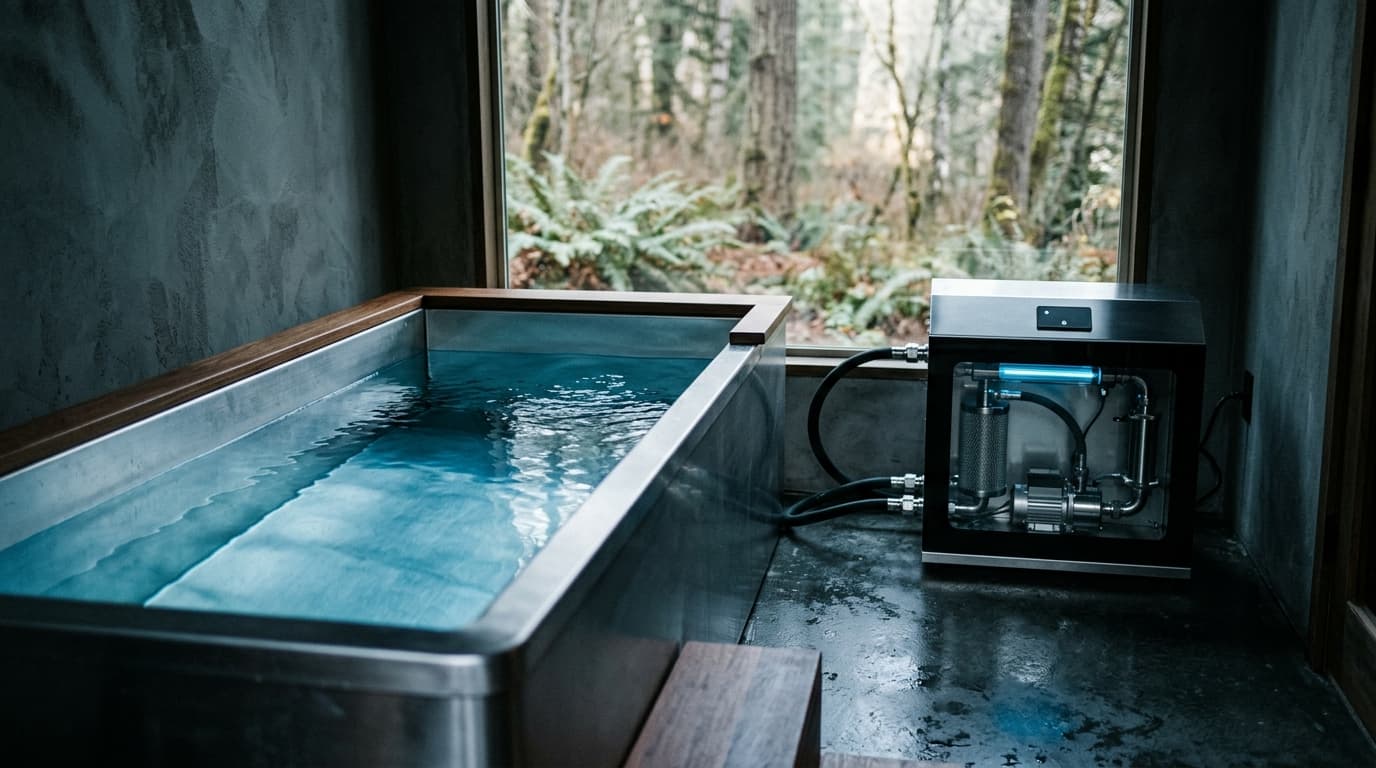
Cold Plunge Water Maintenance: Ozone vs UV vs Chlorine
How often to change cold plunge water by treatment type, what ozone, UV, and chlorine actually cost per month, and the filtration step most owners skip.
Setup
Quick answer: Cold slows bacteria but does not stop biofilm, so untreated plunge water goes cloudy in a few days and you end up dumping and refilling constantly. The three real treatment paths are ozone, UV, and chlorine, usually paired with a filter. With a working system you change water every 4 to 8 weeks instead of weekly, for roughly $5 to $20 a month in chemicals and electricity.
Best for
Owners deciding how to keep water clean, or comparing a plunge with built-in ozone against a bare tub they treat themselves.
Wrong fit
People who fresh-fill with ice for every single session and drain after, who need no treatment at all.
Tradeoff
More treatment equipment and setup cost up front, against far less water changing and hauling over the life of the tub.
Quick Answer
Cold water slows bacteria, but it does not stop biofilm, body oils, or the slick film that builds on the walls. Leave a plunge untreated and it goes cloudy and smells off within a few days, so you end up draining and refilling constantly. That is the hidden chore behind the clean product photos.
Your three real options are ozone, UV, and a chlorine-type sanitizer, almost always paired with a filter that catches the physical gunk. With a working system, most owners change the water every 4 to 8 weeks instead of weekly, and the running cost is small, roughly $5 to $20 a month in chemicals and electricity. The bigger differences are the upfront equipment and how much hands-on effort each method asks of you.
This is the part of ownership the product page skips, and it belongs in your budget from the start. See the full picture in the real cost of a cold plunge.
Why cold water still needs care
People assume near-freezing water is self-sterilizing. It is not. Cold slows microbial growth, which is why a plunge stays usable longer than a warm hot tub, but three things still happen. Body oils, sweat, and skin cells enter the water every session. Biofilm, the slippery layer bacteria form, grows on the walls and in the plumbing. And organic debris clouds the water and feeds whatever is living in it.
The science on exactly how fast this happens in a home plunge is thinner than the equivalent pool and spa research, so treat specific ppm and timing figures here as reasonable estimates rather than lab-verified numbers. The direction is not in doubt: still, untreated water in a tub you sit in every day needs a plan.
The four ways people keep water clean
Method
Upfront cost (estimate)
Ongoing effort
How it works
Water-change frequency
Ozone
$150-$500 add-on, or built in
Low, mostly automatic
An ozone generator injects O3 to oxidize contaminants
4-8 weeks
UV
$150-$400 add-on, or built in
Low, replace bulb yearly
UV light kills microbes as water circulates past it
4-8 weeks
Chlorine or bromine
Under $50 to start
Medium, test and dose regularly
A residual sanitizer you add and monitor
3-6 weeks
Water changes only
$0
High, drain and refill often
No treatment, you replace the water
3-7 days
All four numbers are estimates and depend on how many people use the tub, how often, and how well it is filtered. A single daily user keeps water cleaner than a family of four sharing it.
Ozone
Ozone is the most common built-in system on mid and higher-end plunges, and a popular add-on for DIY tubs. An ozone generator produces O3 and injects it into the circulating water, where it oxidizes oils, bacteria, and organics, then reverts to plain oxygen and leaves no chemical residue. That "no residue" part is why cold plunge owners like it: no chlorine smell, nothing on the skin.
The tradeoffs are honest. Ozone works only while the water is circulating past the injection point, so it depends on your pump and a working generator. Ozone plates and bulbs wear out and need replacing every couple of years. And ozone alone does not hold a residual sanitizer in the water between cycles, which is why many systems pair it with a small amount of chlorine or with UV.
UV
A UV system passes circulating water past an ultraviolet lamp that kills bacteria and other microbes on contact. Like ozone, it leaves no chemical taste or residue, and it runs quietly in the background. The main maintenance item is the bulb, which loses output over time and typically needs replacing about once a year even if it still glows.
UV shares ozone's limitation: it only treats water moving through the chamber, and it holds no residual in the tub itself. It is genuinely effective at what it does, and it is often combined with a filter and a light sanitizer rather than used alone.
Chlorine and other sanitizers
The cheapest path to clean water is a residual sanitizer you add yourself, usually chlorine or bromine, the same chemistry as pools and spas at much lower doses. A residual means there is active sanitizer sitting in the water at all times, not just when the pump runs, which is a real advantage over ozone and UV on their own.
The cost is effort. You test the water, keep free chlorine in a modest range like 1 to 3 ppm and pH around 7.2 to 7.8 as general spa guidance, and dose as needed. Cold water and cold plunge routines do not match pool chemistry exactly, so start conservative and adjust. Some owners dislike any chlorine smell or feel on the skin at all, which is the whole reason ozone and UV exist. If you are sensitive to it, this is not your method.
Water changes only, no system
You can run a plunge with no treatment at all if you drain and refill often, every few days for regular use. This is the honest right answer for two groups: people who fresh-fill with ice for each session anyway, and anyone still testing the habit who does not want to buy equipment yet. It costs nothing upfront. It costs your time and water, and a full tub is heavy to move, which we will get to.
Filtration: the piece people skip
Treatment kills or oxidizes what is living in the water. Filtration removes the physical stuff, the skin, oils, hair, and debris that treatment cannot dissolve. Skip it and even a well-sanitized tub looks cloudy and feels filmy, because the sanitizer is fighting a load a filter should have caught.
Most powered plunges include a cartridge filter in the circulation loop. Rinse it weekly, deep-clean it monthly, and replace it every few months. On a DIY tub, adding even a simple pump-and-filter loop is the highest-value upgrade you can make for clean water, and it makes every treatment method work better. If you are building your own setup, plan the filter alongside the cold plunge chiller, since both live on the same circulation loop.
How often to actually change the water
Your setup
Realistic full change interval
Ozone or UV plus a filter, single daily user
6-8 weeks
Ozone or UV plus a filter, shared by 2-4 people
4-6 weeks
Chlorine or bromine plus a filter
3-6 weeks
Filter only, no sanitizer
1-2 weeks
No treatment, no filter
3-7 days
Change sooner than the interval if the water clouds, smells, or foams, or after heavy use. These are guides, not rules. Your nose and your eyes override the calendar.
What it really costs per month
Cost item
Typical monthly range (estimate)
Sanitizer chemicals
$2-$10
Ozone or UV electricity and part wear
$2-$8
Filter cartridges (amortized)
$3-$10
Chiller electricity to hold temp
$10-$40
Water for changes
Low, varies by local rates
The chiller, not the water care, is usually the biggest line on the monthly bill. A cold plunge holds roughly 80 to 150 gallons depending on the tub, and holding that near freezing is what drives the $10 to $40 a month in electricity. Water treatment itself is cheap. See the cold plunge electricity cost breakdown for how climate and target temperature move that number.
The effort reality
Here is the part that decides which method actually fits your life. Ozone and UV are low-effort by design: they run in the background, and your weekly job is rinsing the filter and glancing at the water. You pay for that convenience upfront and in part replacements. Chlorine is cheap to buy and higher-effort to run, because you test and dose regularly, and skipping it for a week shows.
The heaviest chore for everyone is the water change itself. A full tub weighs several hundred pounds of water, so draining, cleaning, and refilling 80 to 150 gallons is a real task, not a rinse. The whole point of a treatment system is to do that a lot less often. That is the trade at the center of this decision: money and equipment now, against buckets and a hose later.
Which approach fits you
Lead with how much effort you want to spend, not the sticker price.
You want to barely think about it. Choose a plunge with built-in ozone or UV plus a filter, or add one to a DIY tub. Highest upfront cost, lowest weekly effort, longest time between water changes.
You are budget-first and do not mind a routine. A filter plus a small dose of chlorine or bromine keeps water clean for very little money, as long as you actually test and dose.
You are still testing the habit. Run no system and change the water often. It is free, it is honest, and it tells you whether you will keep this up before you buy equipment. Start here, then upgrade.
Whichever you pick, budget the filter. It is the cheapest part and it makes every other choice work.
With ozone or UV plus a working filter, most single users go 6 to 8 weeks between full changes, and 4 to 6 weeks if several people share the tub. With chlorine or bromine plus a filter, plan on 3 to 6 weeks. With no treatment at all, you are changing it every few days. Change sooner any time the water clouds, foams, or smells off, regardless of the calendar. These are estimates that depend on how heavily the tub gets used.
Is ozone or chlorine better for a cold plunge?
They solve different problems. Ozone leaves no residue and needs almost no daily effort, but it only treats water while the pump circulates and holds no lasting sanitizer between cycles. Chlorine is cheap and keeps an active residual in the water at all times, at the cost of regular testing and a possible smell some people dislike. Many good setups combine methods: ozone or UV for hands-off treatment, plus a small residual and always a filter. There is no single winner, only the one that matches how much effort you want to spend.
Do I need a filter if I have ozone or UV?
Yes. Ozone and UV handle microbes and organics, but they do not remove the physical skin, oils, and debris that make water cloudy and filmy. A filter catches that load, and it makes every treatment method work better. On a DIY tub, adding a filter is the single highest-value upgrade for clean water.
Does cold water keep itself clean?
No. Cold slows bacterial growth, which is why a plunge stays usable longer than a warm hot tub, but it does not stop biofilm on the walls or the body oils and debris that build up with use. Untreated water still turns cloudy and smells within days. Cold buys you time, not immunity.
What does cold plunge water care cost per month?
The treatment itself is cheap, usually $5 to $20 a month across chemicals, part wear, and filter cartridges, and all of that is an estimate. The larger monthly number is the chiller electricity to hold the water cold, commonly $10 to $40 depending on your climate and target temperature. Compared with a powered plunge that can run $3,000 to $10,000 to buy, the ongoing water-care cost is minor. The real cost of water care is your time, mostly the water changes.
Methodology
These guides are built from manufacturer documentation, public specifications, primary research where health claims matter, and repeated buyer questions that show up in real ownership and setup decisions.
Manufacturer responses can clarify pricing bands, warranty terms, support footprint, or common mistakes. They do not move a page up the shortlist on their own.