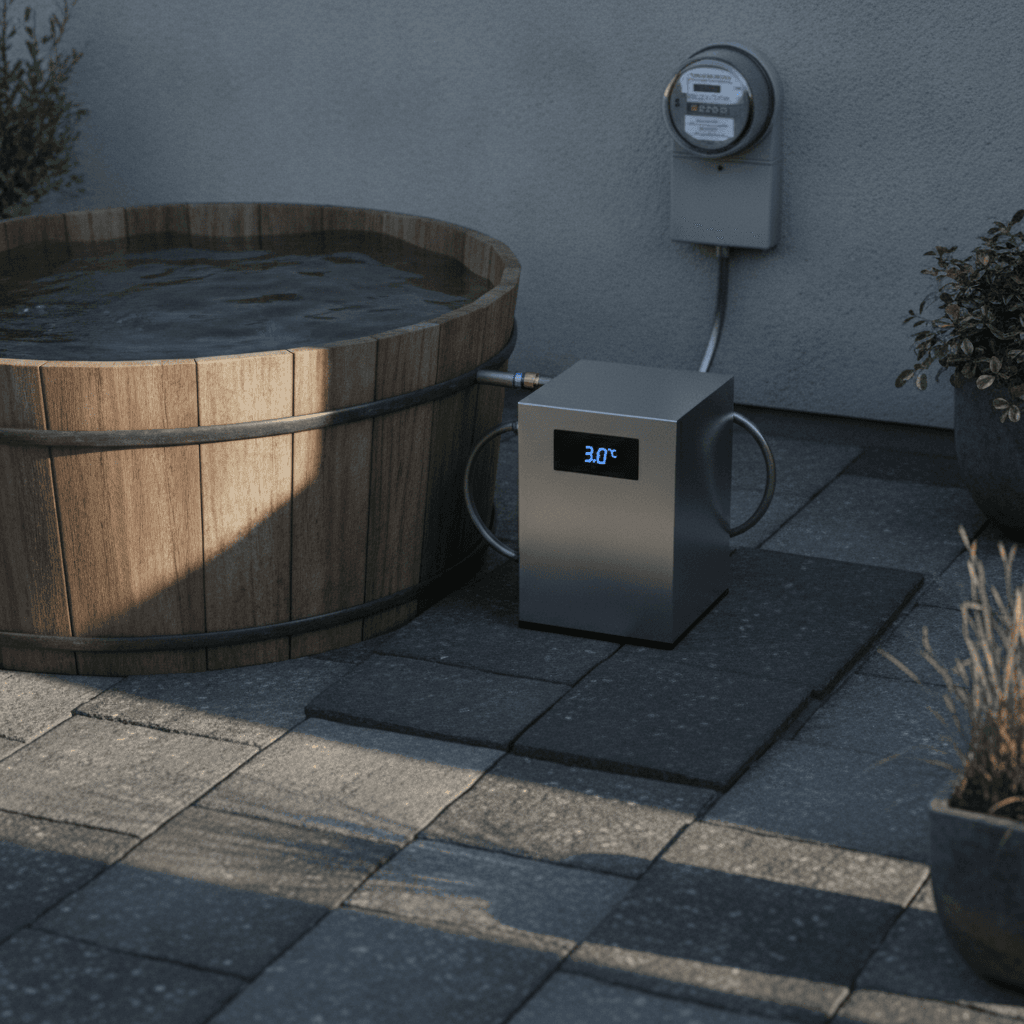
Cold Plunge Electricity Cost: What a Chiller Adds to Your Bill
Real chiller wattage specs, the current U.S. electricity rate, and the actual math behind a cold plunge's monthly power cost, not just another unsourced range.
Setup
Quick answer: Most home cold plunge chillers cost roughly $10 to $35 a month to run, and it can climb past $40 for a larger 1 HP-class chiller working long hours in a hot climate. The number comes from three things: the chiller's real electrical draw in watts, how many hours a day the compressor actually cycles, and your electricity rate (the U.S. average was 17.30 cents per kWh in 2025, per the EIA). A 450-watt chiller (Penguin's 1/2 HP unit) running 6 hours a day costs about $14 a month at that rate. An 830-watt chiller (Penguin's 1 HP unit) running 8 hours a day costs about $34. Watch for one marketing trap: the 'watts' figure on a product page is often a cooling-capacity rating, not the electricity the unit actually draws.
Best for
Buyers who want the real math behind a cold plunge chiller's power bill instead of an unsourced monthly range.
Wrong fit
Buyers who need help sizing a chiller for their climate. See the chiller sizing guide for that decision instead.
Tradeoff
A bigger, colder-running chiller costs more to operate, but duty cycle, not the horsepower label, is what actually decides your bill.
Search "cold plunge electricity cost" and you will get a different number from every result: $10, $25, $45, $80 a month, each stated flat with no math behind it. None of them cite where the electricity rate comes from. Most are written by companies that sell chillers.
We don't sell chillers. We can show the actual math instead: what a real chiller draws in watts, what your electricity actually costs per kWh, and how the two combine into a number you can check against your own bill.
Quick Answer
Chiller
Verified draw
Running 6 hrs/day
Running 8 hrs/day
Penguin Chillers 1/2 HP
450W, 3.9A
~$14/month
~$19/month
Penguin Chillers 1 HP
830W, 7.2A
~$26/month
~$34/month
Sun Home built-in (compressor only)
900W
~$28/month
~$37/month
Sun Home built-in (full input, compressor + pump)
1,150W
~$36/month
~$48/month
Costs use the 2025 U.S. average residential electricity rate of 17.30 cents per kWh (EIA). Your actual hours per day depend on climate, insulation, target temperature, and whether the tub sits indoors, outdoors, or in direct sun, covered in the chiller sizing guide. Treat "6 to 8 hours a day" as a realistic range for a well-insulated setup, not a guarantee for every climate.
The formula, so you can run your own number
Monthly cost is three inputs multiplied together:
(Chiller's watts ÷ 1,000) × hours the compressor runs per day × 30 × your electricity rate per kWh
That is the whole calculation. Every "cold plunge electricity cost" page that skips it is asking you to trust a number it never shows you how it got. The two variables worth understanding before you plug in your own are the wattage (below) and the electricity rate (next).
What electricity actually costs right now
The U.S. average residential electricity price was 17.30 cents per kWh in 2025, the most recent full-year figure from the U.S. Energy Information Administration (EIA), published in its Electric Power Monthly data. That is a national average. Rates vary a lot by state and utility, some regions run closer to 12 cents, others above 30, so check a recent electric bill for your own rate before trusting any calculator's preset number, including ours.
What a real chiller actually draws
Manufacturer spec sheets, not marketing copy, give you the number that matters. Here is what four real products publish:
Chiller
Voltage
Amperage
Wattage
Cooling capacity
Price (checked 2026-08-11)
Penguin Chillers 1/2 HP
100-120V
3.9A
450W
5,000 BTU/hr
$999.99
Penguin Chillers 1 HP
110-120V
7.2A
830W
10,000 BTU/hr
$1,899.99
Sun Home Cold Plunge Pro (built-in)
108-120V
Not published
900W compressor / 1,150W total input
2,600W cooling capacity
Built into the tub
Plunge Pro Chiller (built-in)
120V
15A circuit rating (not draw)
Not published
0.75 HP compressor
Built into the tub
Ice Barrel Chiller (standalone)
~115V
15A fuse rating (not draw)
Not published
"True 1/2 HP"
$3,999.99
Penguin Chillers and Sun Home publish real electrical draw. Plunge and Ice Barrel publish the circuit's overcurrent rating (15A) instead, which tells you the outlet needs to handle up to 15 amps, not what the unit actually pulls while running. Do not treat a 15A circuit rating as a 15A running draw, the two are different numbers and mixing them up overstates the cost by a lot.
The trap: "watts" on a spec sheet is not always your electric bill
Sun Home's own product page proves the point by listing two different watt figures for the same unit: a 900W compressor power draw and a separate 2,600W "cooling capacity." The 2,600W is a cooling-output rating, similar to a BTU/hr figure expressed in watts, not the electricity the compressor pulls from the wall. Plunge Chill's standalone 1 HP chiller advertises "2,600W" and, elsewhere on the same page, "2,700W" of cooling power, and neither figure is an electrical draw spec either. This is the same trap the chiller sizing guide already flags with the "HP" label: brands market a big, cold-sounding number that answers a different question than the one you are actually asking. When you want the electricity-cost answer, ask the seller specifically for input watts or amps at a stated voltage, not "cooling power."
Why the range is a range: duty cycle
A chiller does not run 24 hours a day. It cycles on to pull the water back down to your target temperature, then shuts off until it drifts back up. The hours-per-day figure in the math above, not the wattage, is usually the bigger swing factor, and it depends on:
Climate and sun exposure. An outdoor tub in direct summer sun asks the compressor to fight more incoming heat, so it cycles more often.
Target temperature. Holding the mid-40s (F) costs more cycling than holding 50-55F.
Insulation and a cover. A well-insulated, covered tub holds cold between cycles. A bare tank loses it fast and makes the chiller start over more often.
Indoor vs outdoor. Indoor, climate-controlled placement usually means fewer cycles than an outdoor tub through a hot afternoon.
The chiller sizing guide covers these same four factors for choosing chiller size. They are the same factors that decide how many hours a day it actually runs once installed, which is exactly why a single flat "$X a month" number cannot be honest across every setup.
Does the $10 to $40 range elsewhere on this site still hold?
Mostly, yes, with a caveat worth stating plainly. Our real cost of a cold plunge guide cites $10 to $40 a month as a typical range, and the math above backs that up for a well-insulated setup on a smaller chiller. But a 1 HP-class chiller running a long duty cycle in a hot climate, the worked numbers above put that closer to $40 to $48 a month, can push past that ceiling. Treat $10 to $40 as the common case, not a hard cap for every climate and chiller size.
Powered plunge vs unpowered tub plus chiller: does one cost less to run?
Not by much, once you compare like for like. A powered plunge's built-in chiller and a separate chiller bolted to an unpowered tub, like an Ice Barrel, both do the same job: pull water down and hold it. The running cost comes from the chiller's wattage and duty cycle, not from whether the tub itself was powered or not. Where the setups actually diverge is upfront cost and who sizes the chiller for you, covered in the real cost of a cold plunge breakdown. If you want to run your own full first-year number, including the chiller, GFCI outlet, and water care alongside electricity, the cost calculator does that math with your own inputs. For the same math carried out to a real 24-month total across three setups, see the 2-year cost comparison.
The outlet is a separate cost from the running cost
A chiller's amp rating also decides what outlet it needs, which is a one-time electrical cost, not a monthly one. Do not confuse the two. The GFCI outlet guide covers what to ask an electrician before you buy, separate from the monthly number this guide covers.
Frequently Asked Questions
How much does it cost to run a cold plunge chiller each month?
Most home chillers land between $10 and $35 a month, using real manufacturer wattage and the 2025 U.S. average electricity rate of 17.30 cents per kWh. A larger 1 HP-class chiller running long hours in a hot climate can push past $40. Run your own chiller's rated watts and your local electricity rate through the formula in this guide instead of trusting a flat number from a seller's blog.
How many watts does a cold plunge chiller use?
It depends on the model. Penguin Chillers publishes 450W for its 1/2 HP unit and 830W for its 1 HP unit. Sun Home's built-in chiller draws 900W at the compressor and up to 1,150W total input. Plunge and Ice Barrel publish only their circuit's amp rating (15A), not the chiller's actual running wattage, so their real draw is not public.
Is the "watts" number on a chiller's spec sheet the same as its electricity draw?
Not always, and this trips up a lot of buyers. Some brands list a "cooling power" or "cooling capacity" figure in watts, which describes how much heat the unit can remove, similar to a BTU/hr rating, not how much electricity it pulls from the wall. Sun Home's own spec sheet shows both numbers for the same chiller: 900W of compressor draw versus 2,600W of cooling capacity. Ask specifically for input watts or amps at a stated voltage if you want the number that maps to your electric bill.
Does a bigger chiller cost more to run?
Usually, but not in a straight line. A bigger chiller (more watts) pulls more power per hour it runs, but it can also finish pulling the water down to temperature faster and cycle less often. The real driver of your bill is watts multiplied by hours running per day, and a well-insulated, covered tub with a right-sized chiller can cost less to run than an undersized chiller straining nonstop in a bare, uninsulated tank.
What electricity rate should I use to estimate my own cost?
Start with the U.S. 2025 average of 17.30 cents per kWh from the EIA, then check a recent bill for your actual rate, since it varies significantly by state and utility. Some regions run near 12 cents per kWh, others above 30. Using your real rate instead of a national average will change the estimate meaningfully.
These guides are built from manufacturer documentation, public specifications, primary research where health claims matter, and repeated buyer questions that show up in real ownership and setup decisions.
Manufacturer responses can clarify pricing bands, warranty terms, support footprint, or common mistakes. They do not move a page up the shortlist on their own.