The best cold plunge under $2,000: Ice Barrel, stock tanks, and dropship inflatables compared. What you give up, and when to buy a chiller separately.
Final Decision
Quick answer: Under $2,000 the honest picks are an Ice Barrel ($1,149.99 for the 300, $1,749.99 for the flagship 500), a stock tank for roughly $100 to $500, or a DIY chest freezer conversion. All of them skip the built-in chiller, so you either haul ice or add a separate chiller later. If cold, clean water year round matters more than sticker price, spend the budget on a solid tub plus a right-sized chiller, not a pretty inflatable with an underpowered one.
Best for
Buyers who want to start cold exposure for under $2,000 without buying dropship junk.
Wrong fit
Buyers ready to pay $5,000 and up for a powered, self-chilling unit they never have to think about.
Tradeoff
Under $2,000 you give up the integrated chiller and the water care. You save thousands, but you become the person who manages ice, temperature, and cleanliness.
Under $2,000, there is no unit that chills its own water year round, keeps it clean, and looks finished. That product starts around $5,000. So the real question at this budget is not "which cold plunge is best," it is "which compromise do I want." You are choosing between an honest tub you chill with ice, an honest tub you pair with a separate chiller, and a wall of dropship inflatables pretending to be more than they are.
The good news: cold water does not care about your logo. A $150 stock tank and a $6,000 unit hit the same temperature. What you pay for above $2,000 is convenience and water care, not colder water. That is why starting cheap is a legitimate strategy, not a consolation prize.
Add ~1/4 to 1 HP, or Ice Barrel's own at $3,999.99
Lifetime barrel with limits, confirm term
You add filter or change water
~$1,150 on ice, ~$2,500+ with a third-party chiller
Stock tank
~$100 to $500
No
Add your own
None to speak of
Fully manual
$150 on ice, ~$1,500 with a chiller
Inflatable dropship tub
~$100 to $600
Often a weak "1 HP"
Usually undersized
Thin, often none
Minimal
Cheap up front, often replaced within a year
Chest freezer DIY
~$200 to $700 in parts
Its own compressor
Not rated in HP
None once modified
You add ozone or change water
~$500 plus real electrical and safety work
Tub plus separate chiller
~$1,500 to $2,000
Yes, you choose it
Right-sized for climate
Chiller brand, confirm
Filter plus ozone or UV
The best under-$2,000 cold water, if you assemble it
All figures are widely reported public ranges, not quotes from any brand. Confirm current pricing and chiller specs directly. The single most expensive mistake at this budget is an undersized chiller, so read that column carefully.
Ice Barrel: the safe default
The Ice Barrel is the most credible name at this price for a reason. $1,149.99 buys the Ice Barrel 300, a genuinely well-made upright barrel you sit in, with brand support behind it. The flagship 500, at $1,749.99, adds built-in steps, an interior seat, and room for users up to 6'9", and still squeaks under this budget. Neither chills on its own, so out of the box you cool it with ice. That is fine a few times a week and tiring if you plunge daily.
The honest ceiling here is the same as its floor: it is a shell. Run it on ice and it is a $1,150 barrel you refill. Add cooling and you blow past the $2,000 line: Ice Barrel's own app-controlled chiller is $3,999.99 (a $5,149.98 bundle with the 300), and even a third-party unit puts the project near or over $2,500, which is where the "just buy a chiller separately" math below kicks in. The Ice Barrel is the right pick if you want something proven, tidy, and warranty-backed, and you are fine starting on ice. It is the wrong pick if you want cold water on demand without any effort.
Stock tanks: the cheapest honest entry
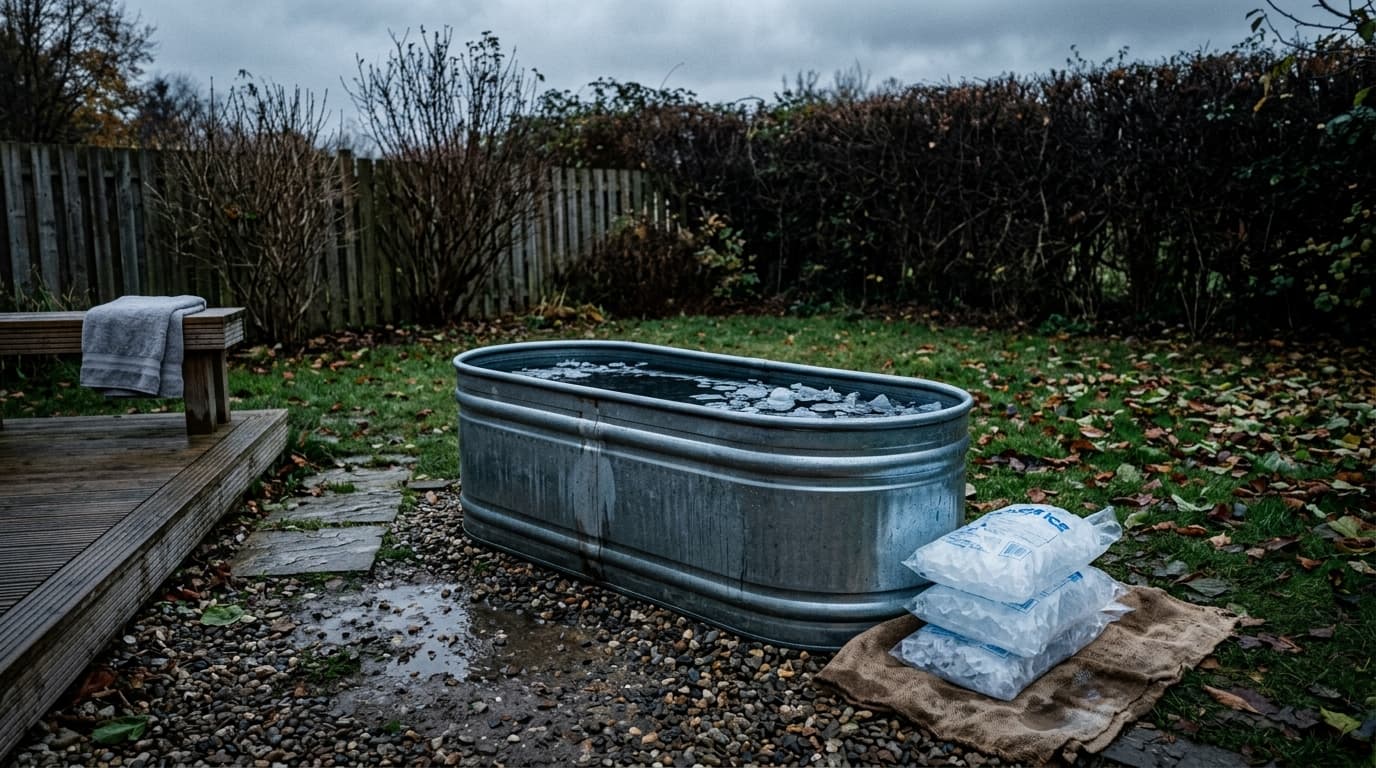
A galvanized or poly stock tank from a farm supply store, roughly $100 to $500, is the least glamorous and most honest option on this list. It is a trough. It holds water, it holds ice, and it works. This is the classic "test the habit for the price of dinner" route, and for a lot of people it is the correct first move.
The unflattering truth is that it is fully manual. No filtration, no chiller, no lid worth mentioning. You manage ice, you manage cleanliness, and it looks like what it is. But if your real question is "will I actually do this three times a week," a stock tank answers it for under $200 before you risk real money. The full setup, the honest ice math, and the water-care routine live in the stock tank cold plunge guide.
Inflatable dropship tubs: name the pattern
Here is the part the other roundups skip. A large share of the "cold plunge" listings under $600, the ones with a slick Instagram ad, an invented brand name, and a bundled "1 HP" chiller, are the same handful of white-label products coming out of the same factories. Different logo, same tub, same underpowered chiller. The credibility is rented, not earned.
Two specific problems. First, the tubs are inflatable or thin-walled and tend to leak, sag, or fail within a season of real use. Second, and worse, the bundled chiller is usually labeled "1 HP" but cannot actually hold cold water in a warm climate. An undersized chiller is the number one cold plunge regret, and these bundles are built around one.
This is not a blanket "never buy inflatable." A cheap inflatable can be a fine way to test the habit, exactly like a stock tank. The rule is: buy it as a disposable tester, not as your real plunge, and do not trust the bundled chiller's HP claim. If you want a longer breakdown, see the honest inflatable cold plunge review.
Chest freezer conversions: cheap, but read the safety part
A converted chest freezer is the DIY favorite, roughly $200 to $700 in parts, and it genuinely holds very cold water. It is also the option where cheap can get dangerous, so this section is served straight.
You are putting a person in water inside a modified electrical appliance. That means a dedicated GFCI circuit is not optional, the electrical work should be done or checked by a licensed electrician, and you have to take water treatment seriously because you cannot easily drain and scrub a freezer daily. Done right, it is a legitimate, very cold, very cheap plunge. Done carelessly, it is a real hazard. Read the chest freezer cold plunge guide and when not to cold plunge before you wire anything.
When to just buy a chiller separately
For many buyers, the best cold plunge under $2,000 is not a product at all. It is a tub plus a chiller you choose yourself.
Pair a solid tub or barrel with a right-sized chiller like a Penguin unit and you get self-cooling, filtered, year-round cold water for often $1,500 to $2,000 all-in. That is a real powered plunge for a fraction of a $6,000 unit. The catch is that you are the integrator: you size the chiller for your hottest month, you plumb it, and you handle water care. If you are comfortable with that, this is the highest-value setup on the entire list.
The one rule that matters most: buy the chiller for your climate, not for the price. A properly sized chiller is the difference between a plunge you love and the regret everyone warns about.
What you give up under $2,000
To keep it plain, here is the honest list of what the extra $4,000 buys above this budget:
Integrated chilling. Under $2,000 you add it or you use ice.
Real water care. Filtration, ozone, or UV usually comes as your own add-on, not built in.
Finish and convenience. A designed lid, a clean footprint, and one company to call.
A warranty on the whole system. You are stitching parts together, so support is per part.
None of that makes cold water colder. If those things matter to you, save up. If they do not, you can be plunging this week for under $2,000 without buying junk. Still deciding between a barrel and a powered unit? Read Plunge vs Ice Barrel. If your budget stretches to $2,000-$3,000, see the best cold plunge under $3,000 for which bundles in that band publish a real chiller spec and which do not.
Frequently Asked Questions
What is the best cold plunge under $2,000?
For most people, an Ice Barrel 300 at $1,149.99 run on ice (or the roomier 500 at $1,749.99), or a tub plus a right-sized separate chiller for $1,500 to $2,000, is the best real option. Stock tanks win on pure price for testing the habit. Avoid dropship inflatables with bundled "1 HP" chillers as your permanent setup, because the chiller is usually undersized.
Can I get a self-chilling cold plunge under $2,000?
Not as a finished product, but yes if you assemble it. A tub or barrel plus a properly sized chiller lands around $1,500 to $2,000 all-in and gives you year-round cold water. You handle the plumbing and water care yourself. Fully integrated units that do this for you start around $5,000.
Are cheap inflatable cold plunges any good?
As a disposable tester, sometimes. As your real plunge, usually not. Many are the same white-label tub sold under different invented brand names, and the bundled chillers are commonly labeled "1 HP" but cannot hold temperature in warm weather. Treat them like a trial, not a long-term buy.
Is a chest freezer conversion safe?
It can be, but only with a dedicated GFCI circuit, electrical work done or checked by a licensed electrician, and a real water-treatment plan. You are adding water to a modified appliance, so the safety steps are not optional. Read the chest freezer guide and when not to cold plunge first.
Should I buy cheap first or save for a real unit?
Starting cheap is a legitimate move. A stock tank or an Ice Barrel on ice lets you confirm the habit for a few hundred dollars before you risk thousands. Plenty of committed plungers started in a trough and upgraded later once they knew it stuck.
These guides are built from manufacturer documentation, public specifications, primary research where health claims matter, and repeated buyer questions that show up in real ownership and setup decisions.
Manufacturer responses can clarify pricing bands, warranty terms, support footprint, or common mistakes. They do not move a page up the shortlist on their own.